
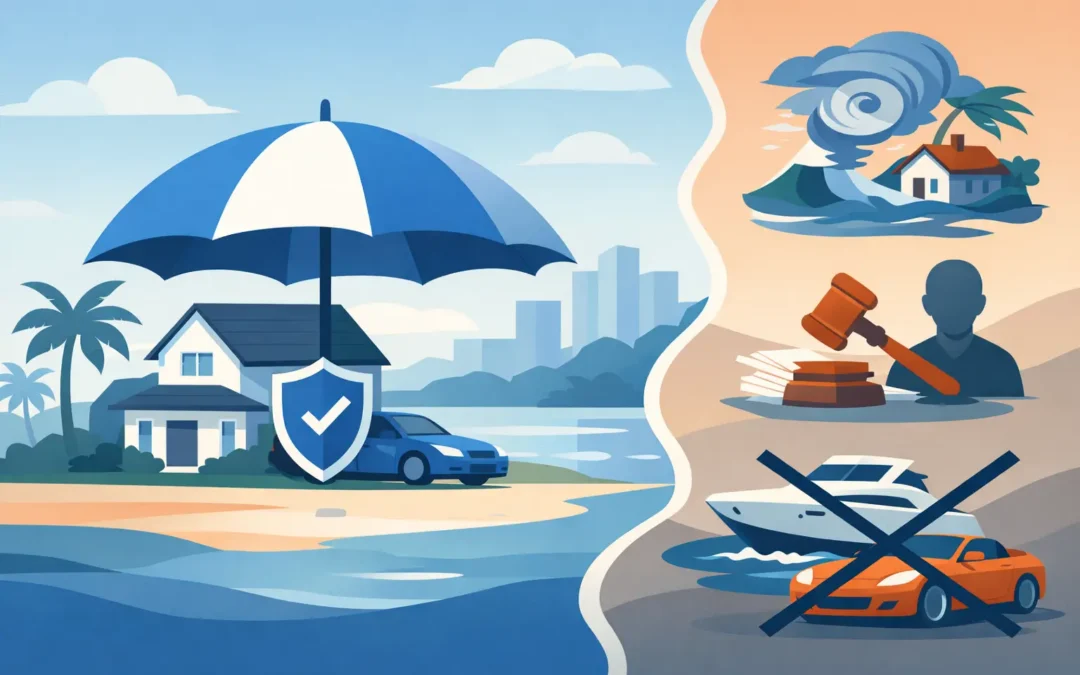
A serious accident can create liability costs far beyond the limits on an auto, home, or boat policy. That is why many Florida families consider umbrella coverage. But before relying on it, ask the practical question: what does umbrella insurance not cover? An umbrella policy is valuable protection, but it is not a catch-all policy for every loss, lawsuit, or expense.
Umbrella insurance generally provides additional personal liability coverage above qualifying underlying policies, such as homeowners, auto, and boat insurance. It may help with legal defense and damages when you are legally responsible for injuring someone or damaging their property. The policy only works within its terms, though, and those terms matter.
What Does Umbrella Insurance Not Cover?
The short answer is that umbrella insurance usually does not cover losses that belong under another type of policy, losses you caused intentionally, or liability that is excluded by the umbrella policy itself. It also does not replace the required coverage beneath it.
Every insurer’s wording is different, so your policy documents control. Still, several exclusions are common enough that Florida households and business owners should understand them before assuming an umbrella policy will respond.
Your own injuries or property damage
Umbrella insurance is primarily liability protection for harm you cause to others. It generally will not pay for your own medical bills after an accident, repair your vehicle, replace personal belongings, or rebuild your home after a covered property loss.
For example, if your car is damaged in a collision, collision coverage on your auto policy is designed to address the vehicle damage. If your home is damaged by wind, fire, or another covered event, the homeowners policy is the starting point. An umbrella policy may become relevant if another person claims you were responsible for their injuries or damage, but it is not a substitute for property, health, disability, or life insurance.
Intentional or criminal acts
Insurance is built to protect against accidents, not deliberate harm. If someone intentionally assaults another person, deliberately damages property, or commits a criminal act, an umbrella policy will typically exclude the resulting liability.
There can be difficult fact patterns. A claim involving self-defense, a teenage child’s actions, or an allegation that has not been proven may require careful review. Do not assume an accusation alone automatically decides coverage, but do not expect an umbrella policy to insure intentional wrongdoing either.
Business and professional liability
A personal umbrella policy usually excludes liability arising from business activities, professional services, or employment-related claims. If you own a company, work from home, rent property as a business, or serve as a consultant, this distinction is especially important.
A customer injured at your business location, an allegation of professional negligence, a contract dispute, or an employee claim may require commercial general liability, professional liability, employment practices liability, or another business policy. Some personal umbrella policies offer limited exceptions for certain incidental activities, but these exceptions are narrow and should never be assumed.
For Florida business owners, personal and commercial risks can overlap. A work vehicle titled to you personally, a side business operated from home, or a boat used for charter can create gaps if the coverage structure is not coordinated correctly.
Liability without required underlying coverage
An umbrella policy sits above underlying liability limits. It commonly requires you to maintain minimum limits on auto, homeowners, boat, or other scheduled policies. If you fail to carry those limits, cancel a required policy, or insure a vehicle incorrectly, the umbrella may not pay as expected.
In some cases, the umbrella insurer may treat you as though the required underlying limit had been paid, leaving you responsible for that amount before umbrella coverage begins. In other situations, a loss may be excluded entirely. That is why changing vehicles, buying a second home, adding a boat, or allowing a young driver to use a vehicle should trigger an insurance review.
Certain vehicles, watercraft, and recreational equipment
A personal umbrella may not automatically cover every vehicle or recreational item your household owns or uses. Coverage can be restricted for vehicles that are not listed, vehicles owned by a household member but insured elsewhere, large boats, certain personal watercraft, aircraft, off-road vehicles, and vehicles used for business purposes.
Florida residents often have more than one exposure to consider: a daily driver, golf cart, motorcycle, RV, boat, or personal watercraft. Each has its own policy requirements and eligibility rules. A golf cart used only within a community, for instance, may be treated differently from one driven on public roads. Likewise, a boat policy may need specific liability limits before it can support an umbrella policy.
Contractual obligations, fines, and certain damages
Umbrella coverage is not designed to pay every amount someone demands in a lawsuit. Policies commonly exclude fines, penalties, punitive damages in some circumstances, and liability you accept solely through a contract. Coverage can also be limited by state law and the facts of the claim.
Florida law, the venue of a lawsuit, and the policy language can all affect whether certain damages are insurable. This is one area where broad assumptions can be costly. If you are signing a lease, serving on a board, hosting an event, or entering a business agreement, the liability you take on may call for a separate review.
Common Coverage Gaps That Surprise Families
Umbrella insurance can offer broad protection, but it does not erase exclusions in the policies underneath it. A few common situations deserve special attention:
- A household member drives a vehicle that is not properly insured or disclosed.
- A rental property is treated as a business activity rather than a personal exposure.
- A dog-bite claim is subject to an animal or breed-related exclusion in the underlying homeowners policy.
- A newly purchased boat, RV, or recreational vehicle has not been added to the appropriate policy.
- A home-based business creates customer, delivery, inventory, or employee-related liability.
The lesson is not that umbrella insurance is too limited to be useful. It is that an umbrella policy is strongest when the policies below it are current, properly structured, and designed around the assets and activities you actually have.
What an Umbrella Policy May Cover Instead
When a covered liability claim exceeds the limit of an underlying policy, umbrella coverage may provide an extra layer of protection. Depending on the policy, it can help with claims involving a major auto accident, a serious injury at your home, an incident involving a covered boat, or allegations such as defamation or false arrest.
Consider a scenario where you are found liable for a severe accident and the injured party’s medical costs, lost income, and legal damages exceed your auto liability limit. After the auto policy pays to its limit, an umbrella policy may help pay the covered amount above that limit, up to the umbrella policy limit.
That added protection matters because liability awards can threaten savings, future earnings, and assets such as a home or investment property. Still, the claim must fit the umbrella policy’s terms and must be supported by the required underlying coverage.
How to Review Your Umbrella Coverage Before You Need It
A productive umbrella review starts with your household, not a generic coverage amount. Look at the vehicles, properties, boats, recreational equipment, drivers, pets, and activities that could create liability. Then confirm that each qualifying policy has the required liability limits and that all household members are disclosed accurately.
Business owners should separately review whether personal assets could be exposed by business operations. Personal umbrella insurance and commercial umbrella insurance serve different purposes, and one does not automatically protect the risks intended for the other.
It also helps to ask direct questions before buying or renewing a policy: Which vehicles and watercraft are covered? Are rental properties included? Does a home-based business create an exclusion? What underlying limits are required? Are there exclusions involving dogs, drivers, or certain activities? Clear answers now are far more useful than discovering an exclusion after a claim.
A local insurance professional can compare the terms of available policies and help identify whether your auto, home, boat, and commercial coverage work together. The right conversation is less about buying the largest limit available and more about making sure the liability protection you purchase fits the life, property, and work you need to protect.